
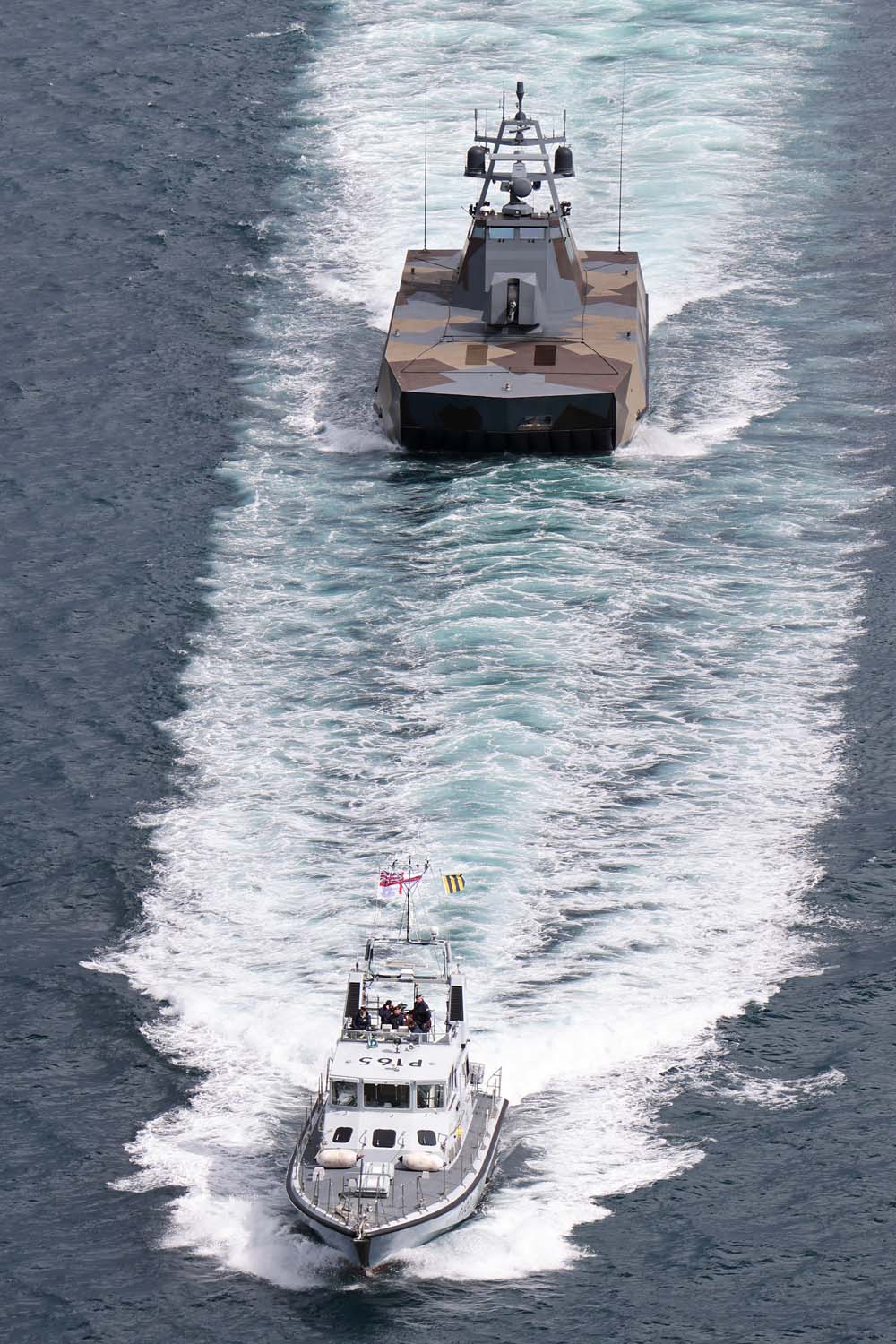
Three action-packed weeks in the fjords saw the British and Norwegian navies enhance missile, fast-boat and drone tactics, reported the Royal Navy’s news team.
Drones were launched, torpedoes dropped and flares cascaded over the waters around Bergen, as Royal Navy Wildcat helicopters grappled with fast attack boats, exploited uncrewed technology and thwarted missile attacks.

Known as Tamber Shield, the exercise has been run for several years under the banner of the Joint Expeditionary Force, the UK-led coalition of northern Europe nations committed to regional security.
The aim of the exercise has remained constant: developing the tactics of Royal and Royal Norwegian Navies to deal with fast, agile threats in narrow waters, with new systems, additional vessels and different scenarios introduced each year.
In 2026, the fresh ingredients were the Royal Navy’s drone squadron 700X and RAF electronic warfare experts from Spadeadam in Cumbria.
The RAF specialists used their equipment to simulate infrared and radar-based missile threats, giving the helicopters extremely valuable practice of evasion tactics, pumping out live chaff (small metallic strips) and flares to throw the ‘missiles’ respectively off the scent.
The involvement of 700X’s Puma drones also helped aircrews increase their ‘kills’ and survivability.
The small aircraft scouted ahead of the helicopters, seeking both potential targets and threats, with the information fed directly into the Wildcat cockpits.
Armed with Martlet missiles, the helicopters from 815 Naval Air Squadron – operating from both the home of the Norwegian Navy at Haakonsvern and the flight deck of HMS Duncan, escorting HMS Prince of Wales – are vital to protecting the fleet against small, fast, highly-manoeuvrable targets: fast-attack craft on the water, drones in the air.

The three Royal Navy fast patrol boats – HMS Archer, Biter and Example – relished the chance to work with the Norwegians’ heavily-armed Skjold-class corvettes in playing hide-and-seek/cat-and-mouse with the air power as they sought to strike blows.
“Hiding in a fjord when we successfully spotted a Wildcat helicopter and were able to ‘kill’ it by simulating a surface-to-air missile attack was particularly enjoyable,” said Able Seaman Rob ‘Scotty’ Scott on his first deployment in the Royal Navy with patrol boat HMS Biter.
“Tamber Shield has been an exciting experience that has allowed me to see more of the world and gain a real insight into life on deployment. It has also been a valuable and interesting experience working alongside other UK forces and Norwegian personnel.”
For good measure, aircrew who’d not done so before were given the opportunity to conduct torpedo runs with impressive drops of Sting Ray torpedoes in the fjords.
“Tamber Shield has been extremely beneficial,” said pilot Lt Hal Wotton of 815 Naval Air Squadron.
“It’s allowed us to refine our tactical development, using the challenging environment of the fjords to simulate realistic threat scenarios, including ambushes and counter-fast-patrol-boat engagements.”
Beyond the high-octane combat elements of the three-week workout, there were opportunities to conduct more general training, such as winching crew on to and off the tiny deck spaces on the P2000 patrol boats.
And ashore, there has been cooperation with the Royal Norwegian Navy through a joint visit to Bergen, including hosting senior officers from the two navies, and participation in the city’s commemorations marking 82 years since liberation from the Nazis at the end of World War 2.
Back at 815 Squadron’s home at RNAS Yeovilton in Somerset a second exercise was run side-by-side testing the ‘mesh’ network which will increasingly be a key part of not just future Tamber Shields but front-line operations, seamlessly sharing data between drones, helicopters and headquarters, to speed up decision making so Martlet operators can take out more targets – especially fast-moving swarm threats – more quickly.